Penicillin was first discovered in 1928. It almost never became useful. Mass production was very difficult. It was not until 1944 that deep-tank fermentation technology made large-scale manufacturing possible. At its core, bioreactors have always been valuable. They “help produce target products on a large scale more efficiently.”
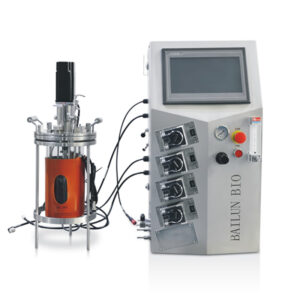
Today, AI and automation are making this core ability even better. They keep the precise control that is important in pharmaceutical manufacturing. They also apply it to precision fermentation uses. Bioreactor design, food proteins and biomaterials are examples. This meets the new demand for “large-scale but low-cost” production.
1、Automation: The Foundation of Biomanufacturing
Biomanufacturing relies entirely on the substances that living cells produce through metabolism. Even small errors can ruin everything. For example, incorrect temperature, too much or too little nutrients, or imprecise inoculation all cause problems.
The main task of automation technology is to reduce these errors through “standardized control.” This lays a good foundation for future improvements.
Bruce Li from TJX Bioengineering divides automation into two types:
- Process automation: It has existed since the 1950s and 1960s. It uses sensors to collect real-time data. Temperature, nutrient levels, and exhaust gas composition are examples. Computers then adjust the bioreactor. This solves the problem of “unstable basic conditions.”
- Workflow automation: This is robotic arm technology developed in the past 10 years. It takes over repetitive manual work. Liquid inoculation and material measurement and dispensing are examples. This solves the problem of “human error due to imprecise operation.”
These two technologies change biomanufacturing from “relying on experience” to “being controllable.” They also collect basic process data. This data is exactly the “raw material” that allows AI to be deeply involved.

2、High-Throughput + AI: Solving the “Data Shortage” Problem
Traditional automation can keep bioreactor conditions stable. It cannot achieve “data-driven precise optimization.” Here is the reason:
AI needs a lot of “success and failure data” first. It uses past and real-time data to predict output or adjust parameters. This has long been a major problem for the industry.
High-throughput parallel bioreactors then appeared. They completely broke this data bottleneck. They can test different conditions in multiple separate tanks at the same time. They can even generate 64 data points in just one week. For comparison: in the past, four PhD students had to share one bioreactor. They could only collect 5 to 6 data points in a whole year.
This large amount of data is combined with AI algorithms. The “predictive model control” that was only a theory in the 1990s finally becomes a reality. It analyzes data to find the best conditions for cell growth and production. The bioreactor can automatically optimize itself.
To put it simply: high-throughput solves the problem of “where to get data.” AI solves “how to use data.” They work together. Biomanufacturing moves from “keeping conditions stable” to “precise optimization.”
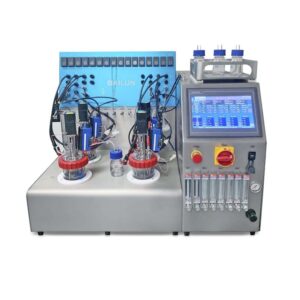
3、Continuous Fermentation + AI: From Lab Optimization to Actual Production
The combination of high-throughput and AI mainly accelerates optimization work in the laboratory. What about the combination of continuous fermentation and AI? It is about breaking through efficiency limits in industrial-scale production. Let’s be honest: any optimization achieved in the laboratory is almost useless. It cannot be converted into stable and reliable production output in actual factories.
Ferbio has specially built a “two-tank continuous fermentation system” to solve this problem. One tank is only for growing cells. The other is completely focused on producing the final product. There is no overlapping of roles or extra troubles. Each tank does what it should do from the beginning. This setup solves the contamination and genetic drift problems. These problems once damaged traditional continuous systems.
AI software can monitor the fermentation process for weeks. It adjusts settings immediately when needed. The effect of this combination is obvious: one tank can produce as much as multiple ordinary tanks. It usually increases productivity by 2 to 10 times. It also reduces the cost of equipment and daily operations. This is exactly the solution that precision fermentation needs. It meets the “large-scale, low-cost” demand. It turns technical breakthroughs into marketable products.
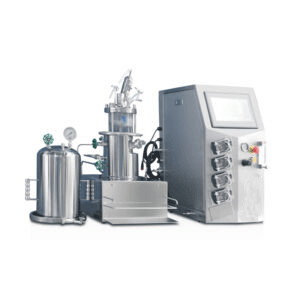
4、Fully Automated Fermentation: Balancing Efficiency and Risk in Reality
AI and automation now cover every step. These steps include process control, optimization and large-scale production. “Fully automated operation” is still rare in practice. The main reason is related to risk and cost: a batch of fermentation may fail. It can cost hundreds of thousands of US dollars. That is why the industry almost always uses “checkpoints.” These are points in the process. Engineers can review key steps. They can approve before proceeding.
Ferbio is advancing intelligent bioreactor technology by building large bioreactor models and an end-to-end synthetic biology platform that connects “strain development to industrial production.” It is creating a precision-fermentation big-data cloud that aggregates massive reaction datasets to monitor, analyze, and predict fermentation parameters and material changes in real time. This enhances the efficiency and accuracy of synthetic-biology R&D and drives the biomanufacturing industry toward greater intelligence, efficiency, and sustainability.