Over the next decade, biomanufacturing will reshape the global industrial landscape and emerge as a key pillar of national competitiveness.
As a technology that utilizes organisms or their components for product synthesis, biomanufacturing is leapfrogging from traditional fermentation processes to a next-generation model underpinned by multi-technology convergence. At the heart of next-generation biomanufacturing lies the deep integration of synthetic biology, artificial intelligence and automation technologies, enabling the transition from bioprocessing to bio-creation. Synthetic Biology acts as the foundational design core of this new model, redefining how biological systems are engineered for industrial production.
According to projections, by 2050, biomanufacturing empowered by Synthetic Biology and cross-technology integration is expected to generate 30 trillion US dollars in economic value, accounting for one-third of global manufacturing.
1 Why Is Next-Generation Biomanufacturing Critical to National Competitiveness?
The global manufacturing industry is at a pivotal stage of green transition and intelligent upgrading. As a green-driven manufacturing paradigm, biomanufacturing with synthetic biology as its core technical support, has been elevated to a strategic priority by numerous countries.
Industrial biotechnology is spearheading a new round of transformation in the manufacturing sector, and the biomanufacturing driven by it represents a new quality productive force with inherent green attributes.
Against the global competitive landscape, major developed economies have accelerated their strategic deployment. The United States has allocated massive funding through the National Biotechnology and Biomanufacturing Initiative.
The European Union has also identified biomanufacturing and synthetic biology as a key pillar of its European Industrial Renaissance, competing for dominance in future manufacturing.
For China, developing next-generation biomanufacturing with synthetic biology carries threefold strategic significance:
- First, safeguarding industrial chain security by reducing dependence on fossil feedstocks through independent and controllable biological routes.
- Second, enabling green transition: biomanufacturing pathways can reduce carbon emissions by more than 60% compared with traditional chemical methods.
- Third, fostering new growth engines. The total scale of China’s biomanufacturing industry has approached 1 trillion RMB, with its fermentation capacity accounting for over 70% of the global total.
2 Core Driving Forces of Next-Generation Biomanufacturing
Non-Grain Feedstock Substitution
Traditional biomanufacturing relies on grain-based feedstocks such as corn and glucose, raising ethical and cost issues of “competing with humans for food.”
Next-generation biomanufacturing empowered by synthetic biology, is accelerating the transition to non-grain feedstocks, utilizing C1 compounds such as methanol, CO₂, lignocellulose, and agricultural waste.
Deep Integration of AI and Automation
Artificial intelligence is deeply empowering the Design-Build-Test-Learn (DBTL) cycle of biomanufacturing and synthetic biology, drastically improving R&D efficiency.
In R&D segments including AI-assisted enzyme screening and engineering, and metabolic pathway analysis, the development efficiency of multiple products has been improved by orders of magnitude. The Ministry of Industry and Information Technology (MIIT) has also selected and released 16 typical application cases of artificial intelligence in biomanufacturing.
Breakthroughs in Engineering Platforms
The core bottleneck of next-generation biomanufacturing is the shift from laboratory R&D to large-scale production, making pilot-scale platforms and engineering capabilities the focal point of competition.
To break through this bottleneck, MIIT and the National Development and Reform Commission (NDRC) have jointly launched the cultivation of pilot-scale capacity platforms for biomanufacturing.
The goal is to cultivate more than 20 pilot-scale platforms by 2027, paving the way for large-scale industrialization.
3 China’s Competitive Advantages in Biomanufacturing
Sound Policy Support System
The 2025 Government Work Report formally included biomanufacturing as a future-oriented industry for the first time.
Since then, a series of supporting policies have been issued intensively, with more than 10 provinces, municipalities and development zones rolling out special policies for synthetic biomanufacturing or biomanufacturing.
MIIT has stated that it will strengthen policy supply and refine the top-level design for biomanufacturing.
Initial Formation of Industrial Clusters
China has formed a biomanufacturing landscape centered on the Beijing-Tianjin-Hebei region, the Yangtze River Delta and the Guangdong-Hong Kong-Macao Greater Bay Area, with differentiated development across multiple regions.
In the past year, the total investment and financing in the biomanufacturing sector reached approximately 28 billion RMB, with over half of the funding flowing into the pharmaceutical and healthcare sectors.
Since the start of 2025, nearly 100 enterprises at home and abroad have completed new rounds of financing.
Encouraged by supportive policies, relevant listed companies have actively participated in the establishment of industrial funds.
4 Barriers to Overcome for Next-Generation Biomanufacturing
Insufficient Pilot-Scale Transformation Capacity
Pilot-scale testing is a critical link in translating biotech innovations into industrial production, yet it remains a major bottleneck for industrial development.
Statistics show that the backward construction of pilot-scale platforms prevents 40% of laboratory achievements from being industrialized.
The market penetration of innovative products in biomanufacturing is less than 15%, requiring stronger policy support for application scenarios.
Shortfalls in Core Technologies
At the upstream tool level, the synthesis of long-chain DNA remains challenging, and the accuracy and efficiency of gene editing need to be improved.
In the construction of microbial cell factories, the design and modification of gene and metabolic networks face high technical barriers.
The accumulation of biological resources such as chassis cells and genetic elements is particularly critical.
Slow Commercialization Progress
Scaling up from the laboratory to industrial production is the decisive factor for the success of biomanufacturing enterprises.
Some technology-focused companies may never transition beyond the laboratory stage.
Biomanufacturing projects feature long investment cycles and high risks, resulting in relatively slow commercialization.Greater support from patient capital and long-term funding is needed.
Over the next decade, with the full integration of synthetic biology, artificial intelligence and automation technologies, biomanufacturing will not only reshape traditional industries but also foster brand-new industrial chains and value chains, providing strong impetus for the sustainable development of the global economy.
The process scale-up of biopharmaceuticals is never a physical process of “making a vessel larger,” but a scientific process of “deepening cognition.”
About Ferbio
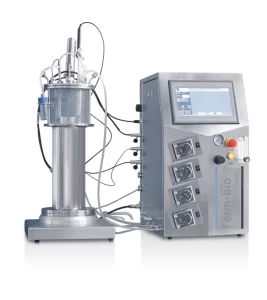
Ferbio drives the intelligentization of bioreactors, develops bioreaction large models, and builds an end-to-end platform for synthetic biology covering “strain development – industrial production”. We have established a precision fermentation big data cloud that aggregates massive reaction data, enabling real-time monitoring, analysis and prediction of fermentation parameters and metabolite changes.
By enhancing the efficiency and precision of synthetic biology R&D, Ferbio empowers the bio-industry to move toward greater intelligence, efficiency and sustainability.