
Antibody therapeutics are developing quickly. Because of this, animal cell culture processes are updated often, and cell culture volume has increased from hundreds of liters to tens of thousands of liters.
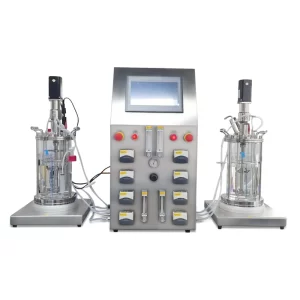
If we look at the antibody production process from cell thawing and recovery, the cell culture and expansion stage takes up most of the total production time. So, the efficiency of the cell culture process is one of the most important factors in antibody manufacturing.
The Quality by Design (QbD) approach is used to develop upstream antibody production processes. With tools such as Design of Experiments (DoE) and high-throughput parallel bioreactors, R&D-scale culture processes can be optimized faster. This helps teams understand the link between Critical Quality Attributes (CQAs) and Critical Process Parameters (CPPs) early. It also helps define the design space for the R&D process.
After the small-scale R&D process is fixed, the next step is scale-up. In an ideal case, the cell culture process can move from R&D scale to pilot or commercial scale within 2 to 4 months. How well this transfer is done shows the experience and skill of the whole process development team.
The main goal of cell culture scale-up is to make sure cells grow in a stable and similar environment while the culture volume increases step by step.
Key indicators of scale-up success include cell density, growth rate, viability, product titer, and glycosylation profile. During scale-up, control parameters can be divided into two groups:
1、Volume-independent parameters: These include temperature, dissolved oxygen (DO), and pH. These values stay the same at different scales.
2、Volume- and geometry-dependent parameters: These include agitation speed and aeration rate. These values change with bioreactor size and design.
During R&D, bioreactors often come from different suppliers. Their materials, such as disposable or glass, are different. Their height-to-diameter ratios and impeller-to-tank diameter ratios are also different. Even bioreactors from the same supplier may not scale in a perfect geometric way. Because of this, it is hard to choose the right agitation and aeration settings for large-scale cultures.
To keep the cell culture environment similar at different scales, developers usually use the following scale-up rules.
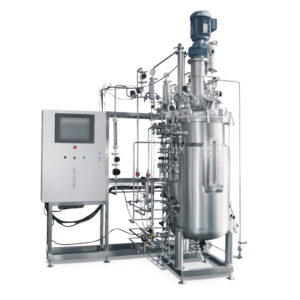 1、Constant Tip Speed
Shear stress is very important in cell culture because different cell lines can handle different levels of shear. Early CHO cell lines had low shear tolerance. New engineered cell lines can handle higher shear.
Shear stress is often described by impeller tip speed. Tip speed depends on impeller diameter and rotation speed. As bioreactor volume increases, impeller diameter also increases. So, when tip speed is kept constant, large bioreactors use lower agitation speeds than small ones. This method keeps shear conditions similar and works well for small-scale scale-up and production.
2、Constant Mixing Time
Mixing time is easy to understand and is often used in the chemical industry. However, in cell culture, small systems below 2 L mix very fast. Large systems need much higher tip speeds to reach the same mixing time. This leads to higher shear stress, and this can damage cells in cell culture.
3、Constant KLa
KLa shows how fast oxygen moves from gas to liquid. Oxygen is very important for cells, so KLa strongly affects cell growth and metabolism. Keeping KLa constant helps provide similar oxygen transfer at different scales.
However, KLa depends on many factors, such as agitation speed and aeration rate. Because of this, many tests are needed to find the right KLa. In real operation, KLa often increases with working volume. At large volumes, oxygen KLa and CO₂ KLa affect each other. This makes it harder to keep KLa constant during scale-up.
4、Constant Power per Unit Volume (P/V)
P/V depends on impeller power number, tank size, impeller size, working volume, and liquid density. It partly shows how well the cell culture system is mixed and how mass transfer happens. Because of this, constant P/V is widely used and is the most common scale-up method today. Since different cell lines have different shear tolerance, a typical P/V range is 10–40 W/m³.
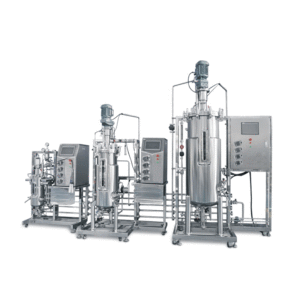
Additional Points for Large-Scale Cultures
When moving to large volumes, the negative effect of pCO₂ on cell growth and protein expression must be considered. In small-scale cultures, aeration removes most of the CO₂ made by the cells. So, CO₂ is usually not a big problem.
In large-scale cultures, CO₂ removal becomes harder because the CO₂ kLa decreases as bioreactor size increases. Gas saturation and bubble number affect how fast CO₂ is removed. Higher aeration rates and longer bubble residence time can improve CO₂ stripping. Some cell culture bioreactor systems now include CO₂ stripping functions to help control pCO₂ more accurately.
About Ferbio
Ferbio boasts extensive experience in manufacturing various types of bioreactors and pressure vessels. The company has assembled a team of experts specializing in bioprocess engineering, fermentation technology, mechanical manufacturing, and automated control. With R&D and process capabilities at the leading domestic level and world-class standards, Bailun is committed to delivering products that provide customers with a reliable, reassuring, and satisfactory experience.