Healthy eating is very popular now. People often talk about “probiotics” and “fermented foods” together. Many people think fermented foods are good sources of probiotics. They even think these two things are the same. But is this common idea correct? How important are probiotics for our bodies? If we understand the link between them, we can pick healthy foods in a smarter way.
Professor Maria Marco works in the Food Science and Technology Department at the University of California, Davis. Her new study shows that the idea “fermented foods are the same as probiotic sources” is not fully right. After strict scientific tests, we find fermented foods usually are not real probiotic sources. Of course, most fermented foods are good for our health. But the reason they are healthy is very different from what “probiotics” actually mean.
I. What Are Probiotics?
Probiotics are living tiny organisms. When you take enough of them, they help your body stay healthy. The Food and Agriculture Organization of the United Nations (FAO) and the World Health Organization (WHO) have clear rules for probiotics. To be called probiotics, these organisms must meet two rules:
- Clear Strains: Scientists must identify them exactly using genome sequencing.
- Proven Benefits: They must show health benefits in at least one randomized controlled trial (RCT).
So only specific tiny organisms that pass strict scientific tests can be called probiotics.
II.What Are Fermented Foods?
Fermented foods and drinks are made when certain tiny organisms grow and change the food’s components. The main goals of fermentation are to make food look, smell and taste better. It also makes food last longer. It is not mainly to add health benefits to food.We can split common fermented foods into two groups:
- No Live Microorganisms Left: This group includes bread, chocolate and beer. After fermentation, these foods are baked, boiled or filtered. The high heat or filtration kills almost all tiny living organisms. So the final product has almost no live microorganisms.
- With Live Microorganisms Left: This group includes yogurt, sauerkraut, kimchi and miso. These foods do have living tiny organisms. But most of these organisms do not meet the strict rules for probiotics. We can not clearly identify their strains. They also have no proof of health benefits from RCTs. So they can not be called probiotics.
III. Health Benefits of Fermented Foods
The live tiny organisms in fermented foods may not be probiotics. But they can still help your health. Here are some examples:
Yogurt: Yogurt has lactase. This substance helps people who can not digest lactose to break down lactose more easily.
Sauerkraut and Kimchi: When these foods ferment, they make special compounds. These compounds are good for your digestive system.
IV.Bad Effects of Misusing the “Probiotic” Label
Calling untested fermented foods “probiotics” can make people confused. For example, news stories often say some foods have lots of probiotics. But these claims have no scientific proof.This wrong use of labels can make real probiotics seem less valuable. Some probiotic strains are proven to reduce diarrhea or respiratory infections. Their real benefits get overlooked because of this confusion.
V. How to Talk About Fermented Foods Correctly?
To avoid confusion, we should use the term “live and active cultures” for fermented foods. We should not call them “probiotics”. This term better describes the tiny organisms in fermented foods. It also stops unnecessary mix-ups.In short, fermented foods are healthy, but they are not usually probiotic sources.We can keep enjoying the good taste and health benefits of fermented foods. But we should only use the word “probiotics” for specific tiny organisms. These organisms must have scientific proof of improving health.People who sell food should also stop misusing the “probiotic” label. This way, consumers can get correct information.
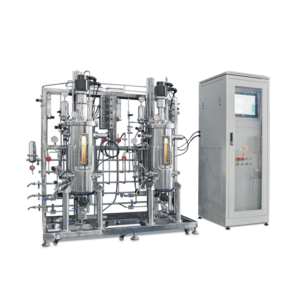
Regarding Ferbio
Ferbio promotes the intelligentization of bioreactors, builds a large-scale bioreaction model and an end-to-end platform for synthetic biology from “strains to industrial production”, constructs a precise fermentation big data cloud, gathers massive reaction data, and conducts real-time monitoring, analysis and prediction of fermentation parameters and substance changes, enhancing the efficiency and accuracy of synthetic biology research and development, and promoting the intelligent, efficient and sustainable development of the bioindustry.