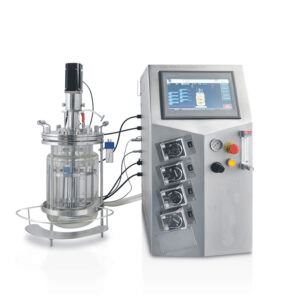
TCM liquid fermentation has become a core technology in the global health industry, revitalizing precious traditional Chinese medicines (TCMs). Once rare, hard-to-absorb, and long-cycle to cultivate, five popular herbs—Phellinus linteus, Dendrobium, Poria cocos, Panax ginseng, and Cordyceps—have completed a remarkable transformation from “luxury rarities” to “affordable staples” through precise regulation in fermentation tanks. TCM liquid fermentation not only enables mass production but also optimizes the content and absorbability of active ingredients, making these valuable TCMs accessible to more people.

1.TCM Liquid Fermentation of Phellinus linteus
Phellinus linteus, a TCM renowned for anti-tumor and liver-protective effects, faced severe traditional predicaments: wild resources are nearly exhausted, artificial cultivation takes 3-5 years, and extracting active components like polysaccharides and flavonoids is inefficient with low dissolution rates. TCM liquid fermentation solves these issues with a “two-stage dynamic regulation” approach.
First, mycelia are cultured in common potato dextrose agar (PDA) medium in seed tanks for 3 days to obtain high-activity mycelium. Then, they are transferred to fermentation tanks with birch sawdust extract to simulate the wild growth environment, plus 0.1% glucoamylase (50,000μ/g) to assist nutrient decomposition. Final tests show that polysaccharide and flavonoid contents are over 30% higher than traditional cultivation.
The entire process is sterilized with 121℃ steam for 30 minutes to avoid bacterial contamination, and the final lyophilized powder retains over 90% activity. Today, fermented Phellinus linteus is widely used in anti-tumor adjuvants and liver-protective drugs, ending reliance on rare wild strains.
2.TCM Liquid Fermentation of Dendrobium
Dendrobium was once a typical “hard-to-cultivate and hard-to-use” TCM: it needs to grow on trees, taking 3-5 years to harvest, and wild populations are nearly depleted. Worse, its large-molecule polysaccharides are barely absorbable when boiled directly, resulting in extremely low utilization. TCM liquid fermentation resolves this through an integrated “tissue culture + fermentation” plan.
First, 0.3-0.5mm tissue blocks are cut from Dendrobium shoot tips and cultured in medium with 100g/L banana puree to produce high-quality seedlings. Then, the seedlings are transferred to fermentation tanks with a composite medium of “sucrose + peptone + banana puree”—sucrose provides energy, peptone supplements nutrients, and banana puree continues to simulate the wild epiphytic environment.
The core breakthrough is that TCM liquid fermentation decomposes Dendrobium polysaccharides into small molecules of 2000-5000Da, increasing the absorption rate from 20% of traditional boiling to over 60%. Fermented Dendrobium works well in both nourishing drinks and anti-aging skincare products, without consuming wild resources.
3.TCM Liquid Fermentation of Poria cocos
Poria cocos, a “spleen-invigorating sacred medicine,” had traditional limitations: it takes 3-5 years to grow underground, and the dissolution rate of active ingredients is less than 15% when boiled, limiting its use mainly as a TCM decoction. TCM liquid fermentation breaks these limitations with “stage-specific nutrient regulation.”
In the first 0-5 days, a high carbon-nitrogen ratio medium is used to promote rapid mycelial proliferation at 26-28℃ with sufficient oxygen, laying the foundation for subsequent active ingredient production. From days 6-12, the carbon-nitrogen ratio is adjusted to 3:1, and special “catalysts” are added to drive the mycelium to synthesize a large amount of polysaccharides and triterpenes.
More ingeniously, the pachymanase produced by the mycelium itself decomposes large-molecule polysaccharides into small molecules less than 10,000Da, increasing extraction efficiency by 5 times and improving absorbability. Today, fermented Poria cocos can not only be made into spleen-invigorating medicines but also integrated into probiotics and children’s food supplements for the whole family to enjoy.

4.TCM Liquid Fermentation of Panax ginseng
Panax ginseng’s pain points are well-known: wild ginseng is extremely expensive, costing thousands of yuan per gram, which is unaffordable for ordinary consumers. Even ordinary ginseng often causes “internal heat” when consumed, making it off-limits for people with sensitive constitutions.
TCM liquid fermentation focuses on “microbial component transformation,” balancing cost-effectiveness and mildness. It uses ginseng fibrous roots, which were previously discarded, to significantly reduce costs. Recombinant Pichia pastoris is introduced, a strain that specifically produces β-glucosidase to convert large-molecule saponins (such as Rb1 and Rc) in ginseng into small-molecule Rh2 and Rg3—these small-molecule saponins are not only mild and non-heating but also more bioactive.
The entire process is cultured at 25-28℃ with a pH of 6.0-6.5 for 48-72 hours, and HPLC testing ensures that small-molecule saponins account for over 60%. The final product costs only 1/10 of wild ginseng (about 1.3 yuan per gram), made into instant ginseng slices and functional drinks, becoming a convenient choice for office workers to replenish energy after overtime without worrying about internal heat.
5.TCM Liquid Fermentation of Cordyceps
Natural Cordyceps sinensis grows in alpine regions, making it difficult to harvest and expensive, costing thousands of yuan per gram. It also poses safety risks of heavy metal exceeding standards. TCM liquid fermentation achieves safe and affordable production by “simulating the plateau environment in tanks.” It uses Cordyceps militaris, a close relative of natural Cordyceps with the same active ingredients. The fermentation process precisely controls temperature: 20-22℃ during the day to promote mycelial growth, and 12-15℃ at night to simulate the plateau’s day-night temperature difference, helping cordycepin synthesis. Finally, a 24-hour low-temperature treatment at 10-12℃ increases adenosine content to over 0.15%.
The medium formula is simple, and mycelium can be harvested in only 15-20 days. Test results show that its cordycepin and adenosine contents are comparable to natural Cordyceps, and it has passed heavy metal testing. Made into nutritional supplements, it costs only 1/20 of natural Cordyceps, which middle-aged and elderly people can easily add to porridge to supplement immunity.
Ferbio promotes the intelligence of bioreactors, builds a big model for biological reactions and an end-to-end platform for synthetic biology covering “strain-to-industrial production”, and establishes a big data cloud platform for precision fermentation. It gathers massive reaction data, real-time monitors, analyzes and predicts fermentation parameters and substance changes, improves the efficiency and accuracy of synthetic biology R&D, and drives the intelligent, efficient and sustainable development of the biological industry.