In-depth Analysis of Safety, Cost and Standardized Processes in Downstream Purification of Biologics.
Biological products — ranging from antibiotics, vitamins to genetically engineered drugs — have become the core pillar of modern medicine, food and agriculture sectors. Their safety and clinical/application effectiveness depend almost entirely on the precise execution of downstream purification processes.
This step is not a simple “purification”; rather, it is a process that systematically separates, enriches and refines high-purity bioactive substances meeting pharmacopoeial and industry standards from compositionally complex fermentation broths. It can be said that purification technology represents the core threshold for the commercialization of microbial drugs and biological preparations, and its technical level directly determines the product quality grade and the feasibility of industrial-scale production.
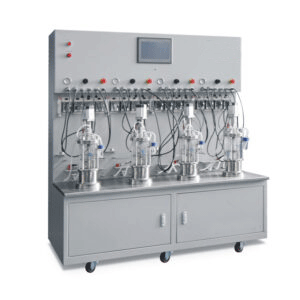
 Purification processes are critical in bioprocessing, ensuring the removal of impurities and the isolation of desired products. The Bailun magnetic stirring glass bioreactor exemplifies advanced technology in this field, offering efficient mixing and optimal conditions for microbial growth. Such systems enhance the overall yield and quality of bioproducts, thereby contributing to the effectiveness of industrial applications. The integration of sophisticated bioreactor designs plays a pivotal role in achieving the desired purification outcomes.
The core challenge of the purification process: The dual predicament of complex systems and active substance protection.
The fermentation broth of biological products is essentially a “chaotic system”: it not only contains the target bioactive substances, but also is mixed with multiphase components such as microbial cells themselves, metabolic by-products, unconsumed medium ingredients (e.g., carbon sources, nitrogen sources, inorganic salts) and cell lysis debris.
What makes it more challenging is that the concentration of target bioactive substances is often extremely low — for instance, the concentration of widely used vitamin B12 in fermentation broth is only about 0.02 kg/m³, which is equivalent to merely 2 kilograms of target substance in 10 tons of fermentation broth, with the remaining 9,998 kilograms being various impurities. Some impurities are highly similar to the target substances in terms of physical and chemical properties (e.g., structurally analogous metabolic intermediates), further increasing the difficulty of separation.
Beyond the complexity of composition, the fragility of bioactive substances poses another major challenge. The activity of most biological products (especially protein and polypeptide drugs) relies on their specific spatial structures. They are highly susceptible to denaturation, inactivation and even decomposition when exposed to factors such as heat, extreme pH values, chemical reagents and mechanical shear forces. For example, if the temperature is improperly controlled during the purification of monoclonal antibodies, their antigen-binding activity can decline by more than 50%. In addition, some high-value-added products (e.g., vaccines and gene therapy vectors) require a sterile environment throughout the entire process. Full-process control, ranging from equipment sterilization to operational isolation, further raises the technical threshold for process implementation.

Cost Composition: The “Cost Peaks” in Biopharmaceutical Production and Industry Constraints
Downstream purification is indisputably the cost hotspot in the total life-cycle cost of biological products. The proportion of post-processing costs varies significantly across different products, but all are far higher than those of the upstream fermentation stage:
- In the production of traditional antibiotics, the equipment investment for the purification stage is approximately four times that of the fermentation stage — this is because antibiotics require multiple rounds of extraction and chromatography to remove residual microbial toxins.
- In the production of organic acids (e.g., citric acid) and amino acids (e.g., lysine), purification costs are 1.5 times those of the fermentation stage, mainly stemming from the processes of crystallization separation and decolorization for impurity removal.
- For genetically engineered drugs (e.g., monoclonal antibodies, recombinant proteins), purification costs account for as much as 60%–90% of the total production cost: such products have extremely stringent purity requirements (usually demanding a purity level of over 99.9%) and require high-precision equipment such as affinity chromatography and ion-exchange chromatography systems. A single chromatography column can cost up to several million yuan, with its packing materials needing regular replacement.
Therefore, optimizing purification technologies and reducing costs has become a key breakthrough for promoting the scale-up and universal accessibility of the biopharmaceutical industry. For instance, replacing traditional batch chromatography with continuous-flow chromatography can reduce the purification cost of monoclonal antibodies by more than 30% while improving production efficiency.
Standardization of downstream purification process flow: Precise control of seven steps from fermentation broth to final product.
Fermentation Broth Pretreatment
Adjust parameters such as pH value, salt concentration, or adopt heating and flocculation methods to improve the properties of the fermentation broth. This lays the foundation for subsequent separation operations and reduces the processing load of downstream procedures.
Cell Separation
Separate microbial cells from the fermentation broth using technologies including sedimentation, centrifugation, filtration, or cross-flow filtration. If the target product is an extracellular substance, the process can directly proceed to the primary purification stage after this step.
Cell Disruption (Exclusive for Intracellular Products)
For intracellular bioactive substances, break down the cell structure to release the target product via homogenization, grinding, enzymatic lysis, or ultrasonic disruption.
Cell Debris Separation
Remove debris generated from cell disruption by means of centrifugation, extraction, filtration, or cross-flow filtration to further purify the feed solution.
Primary Purification
Concentrate the target substance and significantly reduce impurity content using precipitation, adsorption, extraction, or ultrafiltration methods, thereby minimizing the volume of material for subsequent processing.
High-Level Purification
Achieve high-purity enrichment of the target substance by employing precision separation technologies such as gel filtration chromatography, ion-exchange chromatography, and affinity chromatography, ensuring the final product meets quality standards.
Finished Product Processing
Process the purified substance into the final product through sterile filtration, ultrafiltration, crystallization, freeze-drying, or spray-drying processes to guarantee product stability and ease of use.
Regarding Ferbio
Ferbio promotes the intelligentization of bioreactors, builds a large-scale bioreaction model and an end-to-end platform for synthetic biology from “strains to industrial production”, constructs a precise fermentation big data cloud, gathers massive reaction data, and conducts real-time monitoring, analysis and prediction of fermentation parameters and substance changes, enhancing the efficiency and accuracy of synthetic biology research and development, and promoting the intelligent, efficient and sustainable development of the bioindustry.