
In the fields of biotechnology and industrial microbiology, fermentation process plays a crucial role in producing various products—from medicines and biofuels to food and drinks. As the demand for sustainable and scalable biological production grows, modern bioreactor fermentation systems have completely changed how we handle microbial growth and product synthesis.
Narrow Definition of “Fermentation”
In biochemistry or physiology, fermentation refers to a way microbes break down organic substances to produce energy without oxygen. More strictly, it is a redox reaction that uses organic compounds as electron acceptors to generate energy. For example, microbes use glucose without oxygen to produce alcohol and release carbon dioxide, while gaining energy. Another example: pyruvate is converted to lactic acid, and microbes also gain energy from this process.
Broad Definition of “Fermentation”
In industry, fermentation generally refers to the process of using living cells to make certain products or clean the environment. It includes two types of cultivation:
Anaerobic cultivation (without oxygen): Used to produce alcohol, acetone-butanol, lactic acid, etc. Aerobic cultivation (with oxygen): Used to produce antibiotics, amino acids, enzymes, etc.The final products can be microbial metabolites, microbial cells themselves, or enzymes.
Fermentation process
Fermentation process is a metabolic process where microbes convert organic compounds (like sugar) into simple substances such as alcohol, acids, and gases. Depending on the type of fermentation, this process can happen either without oxygen (anaerobic) or with oxygen (aerobic).
Fermentation involves the following steps:
- Glycolysis: Glucose breaks down into pyruvate, and a small amount of ATP (energy) and NADH (a coenzyme) are produced at the same time.
- Anaerobic conditions: Unlike aerobic respiration, fermentation takes place without oxygen.
- Choosing a fermentation pathway: Pyruvate and NADH from glycolysis are processed by different microbes through different pathways:
- Alcoholic fermentation: Yeast converts pyruvate into ethanol and carbon dioxide, and regenerates NAD⁺ (a form of the coenzyme).
- Lactic acid fermentation: Bacteria convert pyruvate into lactic acid, and also regenerates NAD⁺.
- By-product formation: Specific by-products (such as ethanol, lactic acid, acetic acid) are produced based on the chosen pathway.
- Energy production: Compared with aerobic respiration, fermentation produces less ATP. However, it is still important for energy supply in oxygen-free environments.
- Using the products: These by-products are widely used in food production, food preservation, and various industrial fields.
Types of Fermentation
Fermentation can be divided into several types based on its characteristics and microbes’ oxygen needs:
- By raw materials: Sugar fermentation, petroleum fermentation, wastewater fermentation, etc.
- By final products: Amino acid fermentation, organic acid fermentation, antibiotic fermentation, alcohol fermentation, vitamin fermentation, etc.
- By form: Solid-state fermentation and deep liquid fermentation.
- By fermantion process flow: Batch fermentation, continuous fermentation, and fed-batch fermentation.
Divided according to the different oxygen requirements during the fermentation process,
It mainly has two types:
- Anaerobic fermentation: Used to produce ethanol, lactic acid, biogas, etc.
- Aerobic fermentation: Used to produce biomass, antibiotics, enzymes, and other secondary metabolites.
Characteristics of fermentation
The biggest difference is that fermentation process relies on chemical reactions carried out by living organisms. Its main characteristics are as follows:
- Fermentation process is a biological reaction that usually occurs at normal temperature and pressure. It is safe and requires simple conditions.
- The raw materials for fermentation process are usually starch, molasses, or other agricultural by-products. Only a small amount of organic and inorganic nitrogen sources need to be added to start the reaction. Different types of microbes can selectively use the nutrients they need. Thanks to this feature, we can use wastewater and waste as fermentation raw materials to reuse biological resources.
- Fermentation is completed through the self-regulation of living organisms. It has strong reaction specificity, so it can produce relatively pure metabolites.
- Living organisms have their own reaction mechanisms. They can perform highly specific chemical transformations (like oxidation or reduction) on specific parts of complex compounds. They can also produce complex macromolecular compounds.
- Preventing contamination by other microbes is extremely important during fermentation. In addition to strict disinfection of equipment and air filtration, the reaction must be carried out in a sterile environment. If other microbes contaminate the process, it will cause huge economic losses. If bacteriophages (viruses that infect bacteria) appear, the harm to fermentation process will be even greater. Therefore, maintaining sterility is the key to successful fermentation.
- Microbial strains are the basis of fermentation. Through mutation and strain selection, we can get high-yield strains. This not only makes full use of production equipment but also allows us to produce products that are hard to make with conventional methods.
- Compared with other industries, industrial fermentation requires less investment, yields results quickly, and can bring significant economic benefits.
The biggest difference between fermentation and other chemical industries is that it is a chemical reaction carried out by living organisms.
Key Parts of the Fermentation Process
The fermentation process consists of the following steps:
- Determine the composition of the “medium” (a nutrient mixture) used for growing microbial seeds and formal fermentation.
- Sterilize the medium, fermentation tank, and its supporting equipment.
- Cultivate active and sufficient pure microbes, then “inoculate” (add) them into the production container.
- Let the microbes grow in the fermentation tank under conditions that are best for product formation.
- Extract and purify the final product.
Why Is Fermentation Important?
Fermentation has many uses and contributes to many processes, so it is important in various fields:
- It preserves food: Fermentation creates an environment that helps beneficial microbes grow while inhibiting harmful ones. This extends the shelf life of food.
- It produces biofuels: Fermentation process is crucial for making biofuels like ethanol. These fuels can replace fossil fuels, helping reduce pollution and our reliance on limited natural resources.
- It recycles waste: Processes like anaerobic digestion (a type of fermentation) convert organic waste into useful products, such as biogas and compost.
- It makes chemicals: Fermentation is used to produce chemicals like organic acids, enzymes, and amino acids. These are widely used in food, agriculture, textile, and other industries.
- It supports cosmetics: Ingredients from fermentation have potential benefits (such as improving skin health and moisturizing). They are widely used in skincare and cosmetics.
- It advances medicine: Fermentation produces many medicines, vaccines, and therapeutic proteins. These help with medical treatment and biotechnology research.
How Do Bioreactors Improve Fermentation?
A bioreactor is an engineering system that provides a controlled environment for fermentation. It adjusts the following key factors:
- Temperature
- pH level (acidity or alkalinity)
- Oxygen supply
- Stirring and mixing
- Nutrient addition
- Foam control
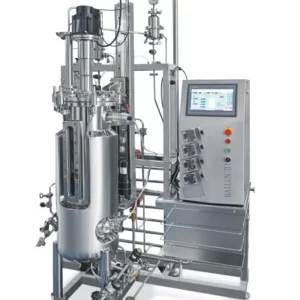
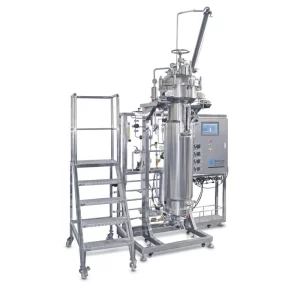
These factors (and other factors that need adjustment) are usually controlled in a fermentation tank. Fermentation tanks are specially designed for this purpose, and they can hold different volumes of materials based on production needs:Lab-scale tanks: Usually hold 10 liters or less. Industrial-scale tanks: Can hold thousands of liters.
Small bioreactor units may have electric heaters. Raw materials (like nutrients and pH adjusters) can be delivered from flasks via a peristaltic pump (a device that moves liquids). Larger tanks have a “jacket” (a layer around the tank). Hot or cold water flows through this jacket to control temperature, and steam can be injected for indirect sterilization. For large amounts of raw materials, they are stored in separate pressure tanks and delivered via a “push pump” made of valves.
By maintaining optimal conditions, bioreactor systems maximize product yield, reduce contamination risks, and enable continuous or batch production on an industrial scale.
The Role of Bioreactors in Fermentation
The core advantages of using bioreactors for fermentation process are:
- Precise environment control: It adjusts conditions accurately to achieve the highest production efficiency.
- Higher yield and consistency: Stable fermentation conditions greatly increase the yield of target metabolites and reduce differences between batches.
- Lower contamination risk: Bioreactors are usually closed systems. They have automatic sterilization, sterile sampling, and air filtration systems, which effectively prevent contamination by other microbes.
- Automation and intelligence: They work with sensors, PLC control systems (a type of automated control), and data analysis platforms. This enables real-time monitoring and intelligent adjustment of fermentation process, reducing manual operation and improving efficiency.
- Easy scaling and replication: From small-scale lab cultivation to large-scale industrial production, bioreactors support flexible scaling. This ensures the fermentation process can be repeated and remains stable.
Common Industrial Uses of Fermentation
- Enzyme production: Enzymes made via fermentation are used in detergents, food processing, and medical diagnostics.
- Bioethanol production: Fermentation converts sugar in biomass into biofuel.
- Antibiotic production: Microbial fermentation is still the main method for large-scale antibiotic production.
- Probiotic and nutraceutical production: Fermentation is key to developing microbial supplements that promote health.

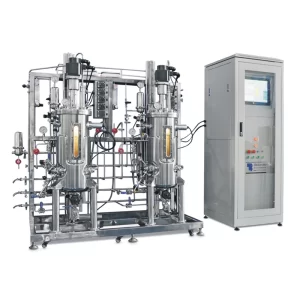
photo bioreactor for spirulina volume 5L~200KL fermenter stainless steel bioreactor plants tissue-SJL
Conclusion: Future Trends in Fermentation Technology
Fermentation technology is developing at an unprecedented speed, thanks to the integration of synthetic biology, AI-based monitoring methods, and sustainable raw materials. The integration of these technologies is reshaping our understanding and practice of fermentation processes—fermentation, as a complex biochemical process, involves multiple stages from microbial strain cultivation to post-fermentation purification.
Ferm-bio is a company focused on utilizing these cutting-edge advancements to optimize every stage of the fermentation process, ensures a dual enhancement of efficiency and product quality. Committed to providing customers with solutions that are efficient, sustainable, and adaptable to changes in industry demands.
Gain in-depth understanding of ferm-bio bioreactor solutions, and acquire specialized equipment designed to ensure precision, meet compliance requirements, and support future scalability.