Choosing between the many types of fermenters isn’t as simple as it sounds. One design might be great for brewing or enzymes, while another works better for large-scale pharmaceuticals. Making the wrong pick can cost both time and money.
If you’ve been wondering which fermenter suits your needs, you’re in the right place. Here, everything is explained simply so it’s easy to follow.
You’ll see how the different types function, what they’re best used for, and how to choose the one that fits your project. By the end, you’ll feel sure about your next move.
What is Fermentation in Biology?
Fermentation is a natural process in which some microorganisms, like bacteria, yeast, and some molds, break down sugars to make energy without needing oxygen. This energy is used to make useful things like insulin, antibiotics, and even yogurt.
Fermentation is different from other ways to make energy because it works best in environments with low oxygen levels. Hence, it’s anaerobic
People have been using this skill for thousands of years. People in the past used it to make beer, bread, and foods like thick soybean paste fermented with different types of grains. Today, pharmaceutical companies use it to make antibiotics, enzymes, and vaccines.
Fermentation is a cheap and easy way for biotech companies to grow cells or make compounds in amounts that natural ecosystems could never match.
Fermenters keep the temperature, pH, and nutrient levels stable for microbes, which lets companies adjust the quality and quantity of products from therapeutic proteins to biofuels.
The Two Types of Fermentation
What are the 2 types of fermentation? Some say aerobic anaerobic respiration, others point to alcoholic fermentation and lactic acid fermentation.
The two main types of fermentation are lactic acid and alcoholic fermentation. Both are anaerobic processes where microbes convert sugars into energy, producing different byproducts.
The confusion between aerobic and anaerobic comes from mixing fermentation with respiration. Fermentation is strictly anaerobic, while aerobic processes fall under respiration, which we’ll touch on next. This distinction guides which type of fermenter you’d need for specific products.
● Alcoholic fermentation:
In alcoholic fermentation, yeasts convert sugars into carbon dioxide and ethanol. This is especially useful in wine and beer production.
As for the equipment requirement when it comes to fermenters, you will need the environment to be free of oxygen completely and with effective CO₂ venting.
Also, sealing the system well ensures there is minimal contamination.
● Lactic acid fermentation:
In lactic acid fermentation, bacteria turn sugars into lactic acid, which gives us products such as probiotics, dairy products like yoghurt, and medications like polymers based on lactic acid.
During the process, you need to understand that lactic acid can prevent growth of the bacteria that produce it.
See, growth is still needed in the initial stages of lactic acid fermentation to establish a population of microorganisms that will then lower the pH. So, when it comes to equipment requirements, there is a need for temperature and pH regulation.
Now, large anaerobic tanks with gas collection systems are beneficial for alcoholic fermentation. On the other hand, smaller stirred-tank reactors with accurate pH monitoring might be needed for lactic acid fermentation in order to manage high acid concentrations.
Fermenter design matching the metabolic route guarantees consistent yields and cost-effectiveness for everything from food companies making yogurt cultures to biofuel companies scaling ethanol.
Cellular Respiration vs Fermentation
It’s easy to confuse fermentation and respiration, so let’s look at cellular respiration and fermentation side by side. Both of these ways help cells make energy, but they do it in different ways.
Cellular respiration uses oxygen to break down sugars all the way, making a lot of energy, water, and carbon dioxide. It’s what your cells do when you take a breath.
Fermentation, on the other hand, doesn’t use oxygen, which means it makes less energy but produces unique byproducts like ethanol or lactic acid. Fermentation is great for biotech processes where there is less oxygen or certain compounds are needed.
- Respiration: High-energy yield, needs oxygen, common in human cells.
- Fermentation: Lower energy, no oxygen, ideal for microbial production.
The by-products of respiration are water and CO₂, whereas fermentation produces ethanol, lactic acid, or other products
| Process | Oxygen Needed | Main Products | Best For |
| Fermentation | No | Ethanol, lactic acid | Food production, biotech |
| Cellular Respiration | Yes | Water, carbon dioxide | High-energy processes |
What This Means For Designing Equipment
To keep oxygen levels stable, aerobic systems need good mixing, high-efficiency spargers, and careful monitoring.
Anaerobic systems, on the other hand, need to completely keep oxygen out. To do this, they need to make seals, control pressure, and collect gas.
Choosing between the different types of fermenters sometimes comes down to whether you need to supply oxygen or keep it out.
Why Is A Fermenter Important For Biotech Work?
A fermenter is more than just a big metal tank; it’s a carefully controlled space where microbes can grow and convert sugars into enzymes, proteins, or biofuels.
The pH, temperature, and nutrient need to stay the same inside, so the yields are always constant
Basic Parts and Design Ideas
Your fermenter needs a few important parts to work right and make the best conditions for growth, no matter what size or type it is.
- Vessel: The main chamber, usually stainless steel but sometimes glass, is durable and easy to clean.
- Agitator or Mixing System: This system makes sure that the cells and nutrients are spread out evenly.
- Aeration System: Provides oxygen when needed and helps get rid of waste gases.
- Control Units and Sensors: It monitors the temperature, pH, and dissolved oxygen.
Now, these important parts are guided by:
- Cleanliness: Smooth surfaces and tight seals.
- Scalability: Start small and move to huge tanks without changing much.
- Saving energy: smart mixing and airflow cut costs .
Choosing the Right Operation
Finally, the mode of operation affects productivity:
- Batch fermentation is easy and cheap, making it great for research and development or small production runs. At the beginning, the ingredients are loaded, and the process goes on until it’s done.
- Fed-Batch Fermentation: The most popular method in the pharmaceutical industry. Adding nutrients slowly lets the process go on for longer and make more.
- Continuous Fermentation: A constant flow of fresh nutrients enters while product is removed, perfect for food processing or large-scale biofuels.
Recent reports from the industry show that fed-batch systems are the most popular in high-value biotech because they give you both control and high output.
Types of Fermenters in Biotechnology
Let’s now get into the different types of fermenters, starting with the stirred tank models, which are very popular because they can do so many things.
1. Stirred Tank Fermenters
These are the most widely used type of fermenter. They are mainly used in large factories and labs of all sizes.
They are Ideal for manufacturing large quantities of pharmaceuticals or food biotech, where the ability to transition from tests to full runs is crucial.
Benefits:
- It allows you to mix and distribute oxygen.
- It is easy to make larger or smaller.
- It is simple to set up for temperature and pH checks.
- Uses bacterial, fungal, or yeast cultures.
Disadvantage:
- Mechanical stirring can stress sensitive cells.
1a. Pilot Scale Fermenter & Bioreactor
As a subcategory of stirred tanks, pilot-scale fermenters link lab experiments to full production. This fermenter uses the same impeller-driven mixing but in mid-sized tanks (5-100 liters), letting you test recipes without burning through resources.
Perfect for R&D in the development of drugs or vaccine trials, simulating real production on a smaller scale.
Advantages:
- A safe place to try out changes to the process before going big.
- Small, but looks like a factory.
- Easy to set up for repeated tests.
- Cheap way to check yields early on.
Disadvantage:
- It doesn’t have a lot of volume, so it’s not good for runs with a lot of output.
1b. Industrial Fermenter
This type of fermenter is built for massive production. It’s commonly used for large-scale pharma, like insulin or antibody production.
Advantages:
- Huge capacity for cost-effective bulk output.
- Tough build for non-stop operations.
- Advanced controls ensure steady quality.
- Trusted in regulated industries.
Disadvantage:
- High setup and utility costs.
1c. Multi-Stage/Parallel Stirred Tank Bioreactor
A networked version of stirred tanks, this type of fermenter links multiple tanks for parallel or staged runs.
Great for advanced biotech, like parallel testing or phased cell therapy production.
Advantages:
- Increases throughput with simultaneous runs.
- Speeds up optimization across scales.
- Flexible for tailored protocols.
- Improves data collection for process control.
Disadvantage:
- Complicated setup with more plumbing and monitoring.
1d. Parallel Glass Bioreactor
The glass walls of this kind of stirred tank provide a clear view of the fermentation process. The clear setup allows you to see reactions without opening the system, which is great for sterile lab work, but the impeller mixes as usual.
It works best for preliminary studies, such as examining how cells ferment and breathe in tiny biotech labs.
Advantages:
- It’s easy to keep an eye on things in real time.
- Not as hard to clean as metal.
- Can handle small, exact amounts well.
- Low risk of contamination and can be used again.
Disadvantage:
- The glass can’t handle a lot of pressure or weight.
2. Airlift Fermenters
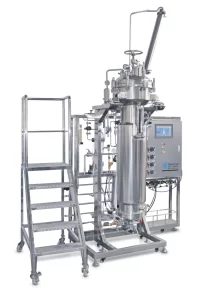
Airlift fermenters are another well-known type of fermenter. It is suitable for shear-sensitive applications, such as the cultivation of hybridomas for diagnostic purposes.
Advantages:
- Gentle mixing avoids cell damage.
- Low energy use with no moving parts.
- Simple design reduces maintenance.
- Strong gas transfer.
Disadvantage:
- Weak mixing in thick broths causes uneven results.
3. Animal Cell Bioreactors
These often modify stirred or airlift fermenter setups, employing low-speed agitation or perfusion.
Benefits:
- Designed with sensitive, high-value cultures.
- High therapeutic protein yields.
- Scalable to volumes of clinical quality.
- Accurate sensors for vital surveillance.
Disadvantage:
- Slow cell growth prolongs production schedules.

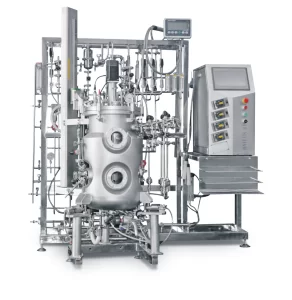
40L-animal-cell-fermentor-40SCUC
4. Plant Cell Bioreactors
Stirred or airlift principles are the foundation of plant cell bioreactors. They are made to work with tough plant tissues and simulate soil by using nutrients and diffused light.
Advantages:
- A sustainable source of rare metabolites.
- Axenic cultures have low levels of contamination.
- Useful for getting secondary products out.
- Better for the environment than field harvesting.
Disadvantage:
- Cell clumping makes it harder to run large-scale tests.
5. Single-Use and Disposable Bioreactors
These types of fermenters use sterile plastic bags or pods instead of metal tanks and shake or rock them to mix them up. They are easy to switch between runs because they are pre-sterilized and thrown away after use.
Revolutionizes vaccine production or small-batch biologics by cutting cleaning time.
Advantages:
- Not having to clean saves time.
- Reduces the chances of cross-contamination.
- Able to change
- Lower costs of capital for each campaign.
Disadvantage:
- Plastic leachables could hurt sensitive items.
6. Solid-State Bioreactors
Lastly, solid-state bioreactors are a special type of fermenter, using moist solids like grains instead of liquids.
Perfect for enzyme or flavor production in food or ag-biotech.
Advantages:
- Cheap substrates cut production costs.
- High product concentration, less wastewater.
- Great for fungi-driven processes.
- Compact for diverse setups.
Disadvantage:
- Uneven heat risks inconsistent yields.
Bringing It All Together
Fermentation is about giving tiny microbes the best place to do their job. We looked at different fermenters, like stirred-tank and airlift, each built for a specific use in medicine, food, fuel, or research.
We also talked about things like cost, size, and upkeep, plus new ideas such as automation and single-use systems.
The bottom line? When you know the options, you can match the right fermenter to almost any goal. That helps you plan better, avoid problems, and keep production running smoothly as biotechnology keeps growing.
Your Partner for High-Performance Fermentation
Great science needs great tools. ferm-bio’s complete line of types of fermenter is engineered for everything from small research runs to full-scale industrial production.
Each system combines durability, efficient mixing, and smart controls to help you achieve higher yields and lower costs. Whether you need a compact lab fermenter or a large stainless-steel reactor, you’ll find a model that matches your goals.
Browse the product lineup today and see how the right fermenter can simplify operations and speed up results. Start building a more efficient fermentation process now.