
In the wave of biomanufacturing, pilot-scale platforms are highly anticipated – they serve as the “bridge” connecting laboratory research and industrial production, and are a crucial link in facilitating the implementation of innovative results. However, the ideal is overly optimistic while the reality is quite harsh.

The production lines of many pilot-scale platforms are overly “specialized”, with a serious tendency towards single-product orientation, lacking flexible configuration and scalability.
Ⅰ. Once the market demand changes, these highly costly production lines are likely to become idle and useless.
Let’s first look at a crucial question: What does “flexibility” mean?
In the context of manufacturing, “flexibility” means that the system can quickly adapt to the demands of different products, different processes, and different scales, achieving the capability of “one machine for multiple uses and one button for switching”.
It is not a collection of static equipment, but an intelligent system that responds dynamically and is flexible in its allocation.
However, in most current biomanufacturing pilot plants, this “flexibility” has become a luxury.
ⅰ. Uniform at the upstream stage, diverse at the downstream stage
The upstream fermentation process is relatively standardized, with certain commonalities in equipment such as fermentation tanks, culture media, and control parameters, resulting in a high equipment reuse rate. However, things are completely different at the downstream processes – extraction, purification, and refinement.
The downstream processes for manufacturing products by each type of organism can vary greatly:l
- Antibiotics vs. Amino acids vs. Enzyme preparations vs. Protein drugs…l
- Some require ion-exchange chromatography, while others rely on crystallization separation;l
- Some are pH-sensitive, while others require low-temperature operations;l
- Some demand high purity, while others aim for high yield.
This means: The downstream equipment must be customized according to specific processes, and it has extremely low versatility. You cannot use the same sophisticated system to produce both insulin and citric acid simultaneously, which makes it impossible to build a flexible production chain.
ⅱ. Scale differences exacerbate “rigidity”
The scale during the pilot stage is inherently unstable. Some projects only require verification at a hundred-liter scale, while others need to be scaled up to the ton level. Moreover, the design of the equipment is often based on a specific scale. Once the product or batch changes, the entire process needs to be adjusted or even replaced.
This resulted in an awkward situation:The equipment is designed to serve specific processes and scales, rather than being created for “flexible adaptation”.
Even if you attempt to enhance flexibility through modular design, as long as the core process paths are not consistent, the so-called “flexibility” is merely theoretical.
Ⅱ. Flexibility: Is it a technological ornament or a future direction?
Some people say: “The term ‘flexibility’ sounds nice, but it often turns out to be just a technical ornament that looks good but is useless and wastes resources.”This statement may sound harsh, but it actually points out the pain points of the industry.
Indeed, many so-called “flexible platforms” merely assemble several devices together and affix the label of “switchable”, but they are still stuck in the mindset of a “single-product assembly line”. There is no unified data interface, no intelligent scheduling system, and no standardized interface protocol. The so-called “flexibility” is merely a false proposition.
But our question is: Isn’t there any possibility that the pilot production platform could truly become “flexible”?
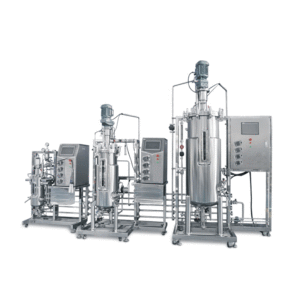
Ⅲ. What does a truly flexible biomanufacturing platform look like?
If we look to the future, a truly flexible biomanufacturing platform should possess the following characteristics:ⅰ. Modular architecture + Standardized interfaces
Just like Lego blocks, the unit operations such as fermentation, centrifugation, filtration, chromatography, and drying are decomposed into independent modules. Each module has standard input and output interfaces (such as pipes, valves, and sensors), and supports plug-and-play functionality.For instance: Today we are producing enzyme preparations, using the A+B+C module; tomorrow we will be manufacturing vaccine intermediates, and we will switch to the A+D+E module. No large-scale renovation is required.
ⅱ. Digital twin + intelligent scheduling system
Establish a full-process digital twin model to monitor the status of each module in real time, and automatically match the optimal process path. When a new product is launched, the system can automatically generate a running plan and guide the operators to complete the switch.
ⅲ. Cross-product process database + rapid verification mechanism
Accumulate process data of different products to form a knowledge graph. When a new project is initiated, the system can recommend similar process routes and estimate key parameters, thereby shortening the development cycle.
Similar to AI-assisted diagnosis, but applied to biomanufacturing.
ⅳ. Small batch, high frequency, low cost pilot production capability
Break the traditional model of “one-time investment, long-term use”, and create a “on-demand activation, per-use billing” shared pilot service model. Enterprises can rent platform resources by project to avoid heavy asset burden.
Ⅳ. Flexibility is not a gimmick; it is a fundamental necessity for survival.
In today’s world where market fluctuations are intensifying and technological iterations are accelerating, flexibility has become one of the core elements of a company’s competitiveness.
For start-up enterprises and research institutions, if the pilot production platform fails to offer sufficient flexible support, it will mean higher trial-and-error costs and slower transformation speed; for large enterprises, rigid production lines are also unable to cope with the demands of multiple product categories and short production cycles.
Therefore, flexibility should not be seen as an “add-on” but rather as a “life-saver” in times of need.
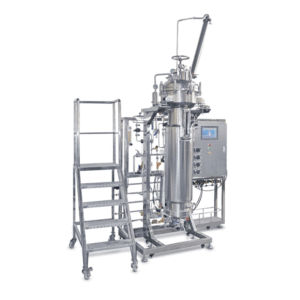
Ⅴ. Returning to the original question: Why can’t the pilot production platform achieve flexible production?
The answer might be: We built it too early as a “factory” rather than as an “experimental site” when designing it.The future pilot platform for biological manufacturing should not be a “scale-up” facility for a single product, but rather an “incubator” for diverse innovations. What it requires is openness, adaptability and intelligence, rather than being closed, rigid and costly.
Only by embracing flexibility can the pilot production platform transform from a mere decoration to an engine driving industrial transformation.
Conclusion
Ferbio promotes the intelligentization of bioreactors, builds a large-scale bioreaction model and an end-to-end platform for synthetic biology from “strains to industrial production”, constructs a precise fermentation big data cloud, gathers massive reaction data, and conducts real-time monitoring, analysis and prediction of fermentation parameters and substance changes, enhancing the efficiency and accuracy of synthetic biology research and development, and promoting the intelligent, efficient and sustainable development of the bioindustry.